
DEVELOPER: CD PROJEKT RED
LAUNCH DATE: september 26, 2026
hours played: 120
platform: pc
A conversation reaches a fever pitch and you now stand at a fork in the road with the fate of a character or dispute in your hands. The paths before you are winding, and the moments that pass while you try to sort out which way to go feel like an eternity under the weight of their potential consequences. You make a choice, watch the events unfold, and your journey continues, but you're left wondering what your next steps may have looked like down another path. The Witcher 3: Wild Hunt is brimming with moments like these that force you to look inward and challenge your own moral compass. Eleven years after its initial launch, it's hard not to think about all the games that have been influenced by the Witcher 3's expertly handcrafted narrative design, rich yet harsh open world and robust combat, item, and economy systems -- which have only been improved thanks to an impressive remaster. Rivaled only by its DLCs and a follow-up in the Witcher 4 coming in 2028, the Witcher 3 is the RPG masterpiece that just keeps on giving -- and one that is surely to continue to stand the test of time.
The Timeless Story of a Monster-Hunting Legend
If you're like me and you picked up the Witcher 3 over a decade after its initial launch, it's natural to wonder if you should play the previous two games to ensure your experience here is enjoyable. After spending over 100 hours navigating this sprawling story, the answer is well, complicated. Geralt of Rivia's journey begins in the midst of his search for the renown sorceress, Yennifer, as he aims to seek her help to find and rescue his "adopted" daughter Ciri from the clutches of the Wild Hunt. If not for the game's opening sequence that establishes Geralt's relationship with Ciri, the initial steps of the journey would feel like stepping into well-worn Witcher's boots. Beyond the opening, CD Projekt Red's writers go to great lengths to craft context-heavy dialogue sequences in such a way that newcomers can still enjoy them. The only problem is that Geralt goes way back with the game's main cast of characters, and witnessing his dialogue with them can sometimes feel like being the third wheel in a conversation between two long-time friends. In the end, regardless of whether or not you've played the first two Witcher games, the Witcher 3's story and characters are written with so much care, finesse and variety, that eventually, past events fade into a captivating present journey.
Though, it doesn't achieve that feeling right away. Like any good story, the Witcher 3 takes its time to world-build and give you a reason to care about its characters. In fact, it doesn't take its first big narrative swing until the Bloody Barron quest which takes a short while to reach. This is a risk that pays dividends for those who opt to stick around for it, because it serves as the introduction to the game's best narrative achievement -- creating a story built on moral ambiguity and impossible choices. At many points during this quest, I found myself stepping away from the game to ponder the gut-wrenching dialogue choices. At its conclusion, I felt that the choices I made lead to the most favorable outcome, but I couldn't help but contemplate other possibilities. Little did I know, this feeling would stick with me, as the Bloody Barron quest serves a small, yet important taste of the morally complex journey that follows. Despite it's intended effect, however, this was not the quest that turned me into a believer.
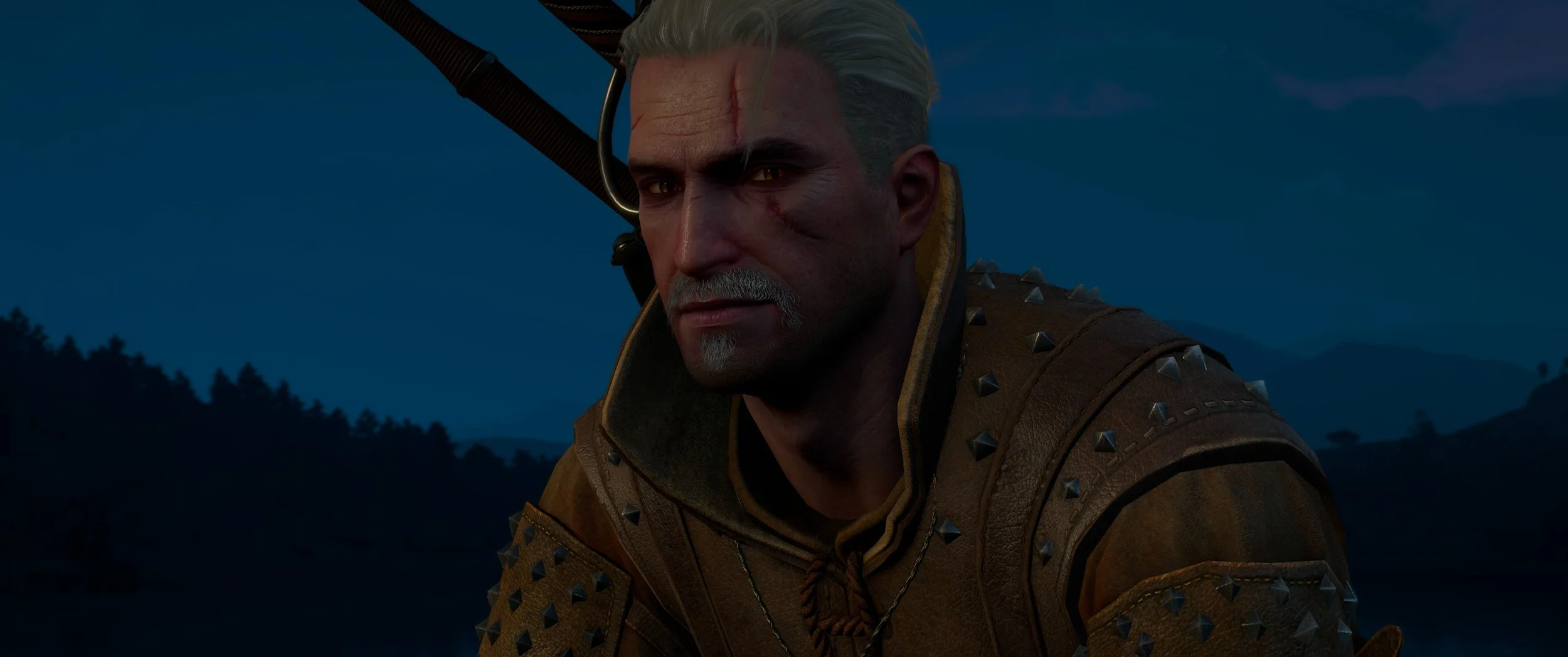
While passing from town to town in the Velen country-side, a priest of the Eternal Fire pulls me to the side and presents a contract to clear out a nearby mine. What begins as a fairly straightforward task evolves into an hours-long saga that saw me navigate the moral complexity of the church and deciding whether or not to help the characters involved shift their world view to what I as the player consider to be "correct". In narrative-focused video games, you expect the main quests to feature layers of rich, thought-provoking storytelling, but when it exists in completely missable side quests, then the entire experience is elevated to unforgettable heights.
At the end of this quest, my excitement for the journey ahead reached a fever pitch, and I soon found myself turning every stone I could find to happen upon stories like these. Thankfully, there are many, seemingly countless of them on the path. For example, Witcher contracts rarely ever see you simply hunt down a monster and collect a reward. At the very least, the task giver has strange intent behind their contract, and at most, the hunt that seemed simple on the surface evolves into a deep, thrilling adventure. The same possibilities exist in secondary quests and treasure hunts -- you just never know what you're going to get until you take up the job. What's more, compared to the Third Northern War gripping the populace, Geralt's search for Ciri lies low on the totem pole of priorities for many of the people he crosses paths with. As a result, many side quests see Geralt forced to contend with the conflicts of the wider world, making the world feel much bigger than his golden path. For me, this created a great conundrum. In moments when I found myself wanting to savor the main story, I would turn to side quests until I felt ready to return, but the side quest content was so thrilling, that I struggled to decide what to conserve and what to pursue.
At the center of the Witcher 3's narrative masterpiece are its cast of main characters -- each boasting distinct personalities that are brilliantly portrayed through the game's superb writing. Look no further than Geralt himself for evidence of this. His mutation-driven stoicism would suggest that his interactions should be dull, yet, through a combination of Doug Cockle's masterful voice acting and CD Projekt Red's incredible writing, Geralt's emotions are fully on display through the nuanced words he speaks, rather than the way he speaks them. Playing witness to his gruff attitude clash with Yennefer's cold, unrelenting sarcasm, or somehow fitting like a puzzle piece into Dandelion's silly, light-hearted demeanor makes for a deeply entertaining ensemble cast to journey with. Geralt is the canvas on which the game's main and side characters portray their distinct personalities, and as a result, the Witcher 3 presents a strikingly diverse and well-rounded story touching on countless themes from romance, political intrigue, prejudice, and everything in between.
“Geralt's emotions are fully on display through the nuanced words he speaks, rather than the way he speaks them.”
To Slice or to Cast?
Geralt is steadfast on working alone. For him, doing so paves the way for a successful hunt. For the player, it means constantly being outnumbered, and in some cases, overpowered. Geralt may carry two swords, but even they alone aren't enough to overcome the odds consistently stacked against him. That's why it's in the player's (and his) best interest to weave between swordplay and sign-casting. However, at first, finding this balance feels cumbersome. Your first few encounters will likely see you fumbling through the radial menu trying to remember what each of your five spell signs do while a group of monsters that outnumber you go in for the kill. The difficulty here is that you simply won't survive this harsh world or its grueling encounters without mastering this system. Thankfully, the Witcher 3 designs certain encounters to cleverly onboard you to the process.
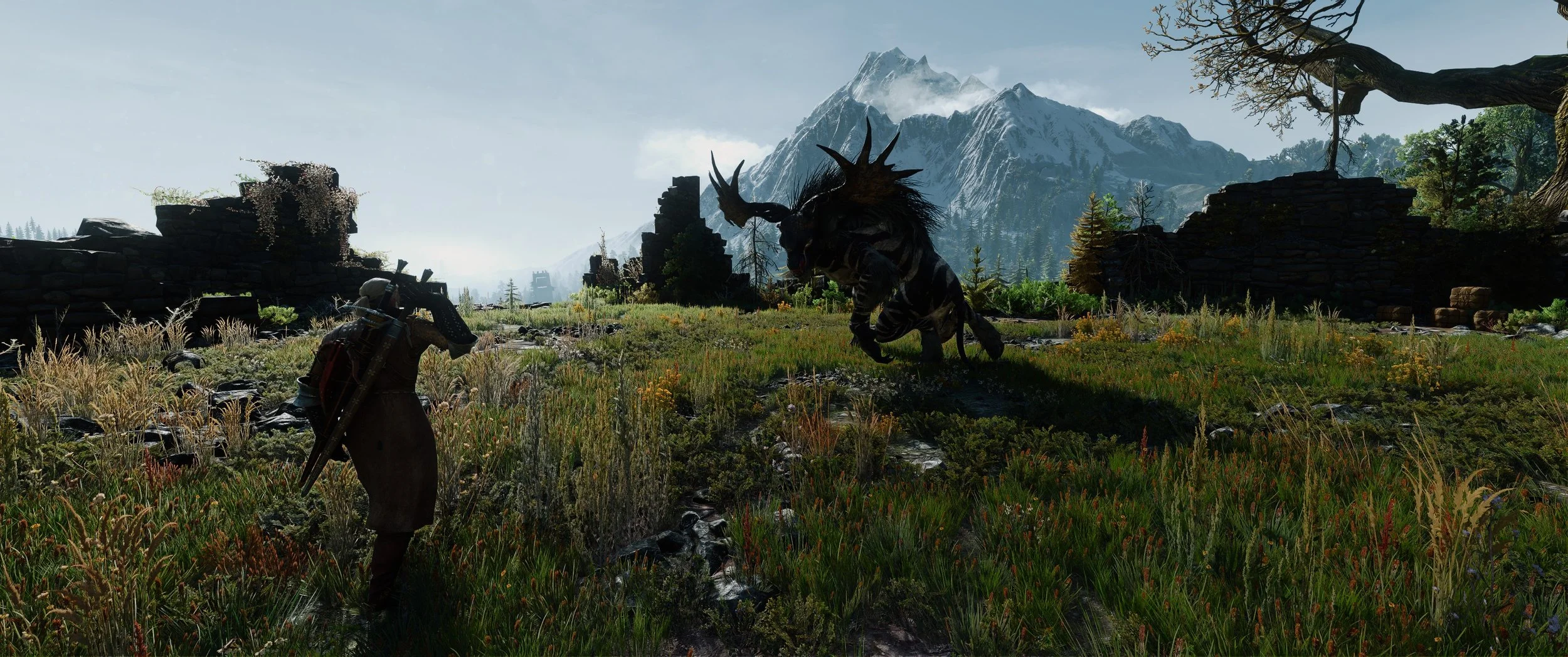
I can recall early on showing up to a wraith fight thinking I could bash my way through the encounter with just my silver sword. Though my strikes were well-aimed, the only thing I managed to slice was air. After experimenting with my spells, I discovered that the only way to force a wraith into its vulnerable physical form was to cast a magic trap. From that point on, weaving between Yrden and my silver sword became the key to my success, and would lay the blue print for how I would approach every battle going forward. A dozen hours in, and I found myself seamlessly weaving signs between sword strikes to make easy work of monster hordes. When paired with the game's robust weapon scaling and crafting system, mastering combat delivers a satisfying power fantasy that effectively puts you in the shoes of a seasoned monster hunter. Getting to this point reminded me of my time with Sekiro. The Witcher 3's combat difficulty isn't nearly as brutal, rather, it's similarity lies in how it asks you to play a certain way to unlock the fun hiding underneath its challenging first impression.
“…mastering combat delivers a satisfying power fantasy that effectively puts you in the shoes of a seasoned monster hunter.”
Unfortunately, one aspect of the Wither 3's combat experience that struggles to progress beyond it's challenging first impression is it's moment-to-moment feel. Geralt's movement is bulky, and his strikes land like a silver sword slicing through an un-trapped wraith -- like air. His pirouette sword-style presents a graceful sword dance that visually captivates, but the long wind ups that load each strike throughout the dance feel sluggish in practice. So, does this make the combat experience bad? Not necessarily. As you progress through the game's many battles, it becomes a decent, manageable part of an otherwise stellar experience. Though, unlike the satisfaction of balancing sword play with casting, coming to grips with the game's combat feel doesn't feel like a challenge the player is meant to overcome, rather, it's a part of the game that simply becomes tolerable instead. When looking back on my tme living out Geralt's adventures, my one wish is to have found more fun swinging my beautiful duo of swords.
Dear World, Serve the Story
Since the Witcher 3's launch more than a decade ago, open-world design has bloomed in a number of different directions. Games like Breath of the Wild and Elden Ring have revolutionized complete player freedom, while others like the more recent Assassin's Creed games have pushed map density to their absolute limits. Regardless of their structure, these worlds each have one thing in common -- they're all designed to invite players to move through them like playgrounds. Spaces have become more vertical, allowing for a more diverse range of movement. By comparison, the world of Witcher 3 is extremely grounded, not necessarily in its tone, but in the way you move through it. Geralt pushes through the terrain like a semi truck. No, I don't mean he barrels through walls like he's completing a high-stakes mission in battlefield. Rather, his movement is designed to convey the weight of each step he takes. He isn't jumping off cliffs, falling from the sky, or climbing the sides of mountains -- the world he's in doesn't ask him too. Instead, he walks the path, beaten or unbeaten, with his own two feet every step of the way.
One could argue that comparing the Witcher 3's open world to ones that succeed it isn't giving the Witcher 3 a fair shake. While that's certainly true, the influx of players either coming back to the game today, or who are experiencing it for the first time because of the remaster, make the comparison an inevitable conversation. The Witcher 3's open world is not a playground, and that may disappoint some players who see Skellige's mountain ranges and feel inclined to climb them. I certainly found myself itching to traverse in ways that other games have made common-place. So, does this mean that the world of the Witcher 3 would be more fun to move through if it were more like a playground?
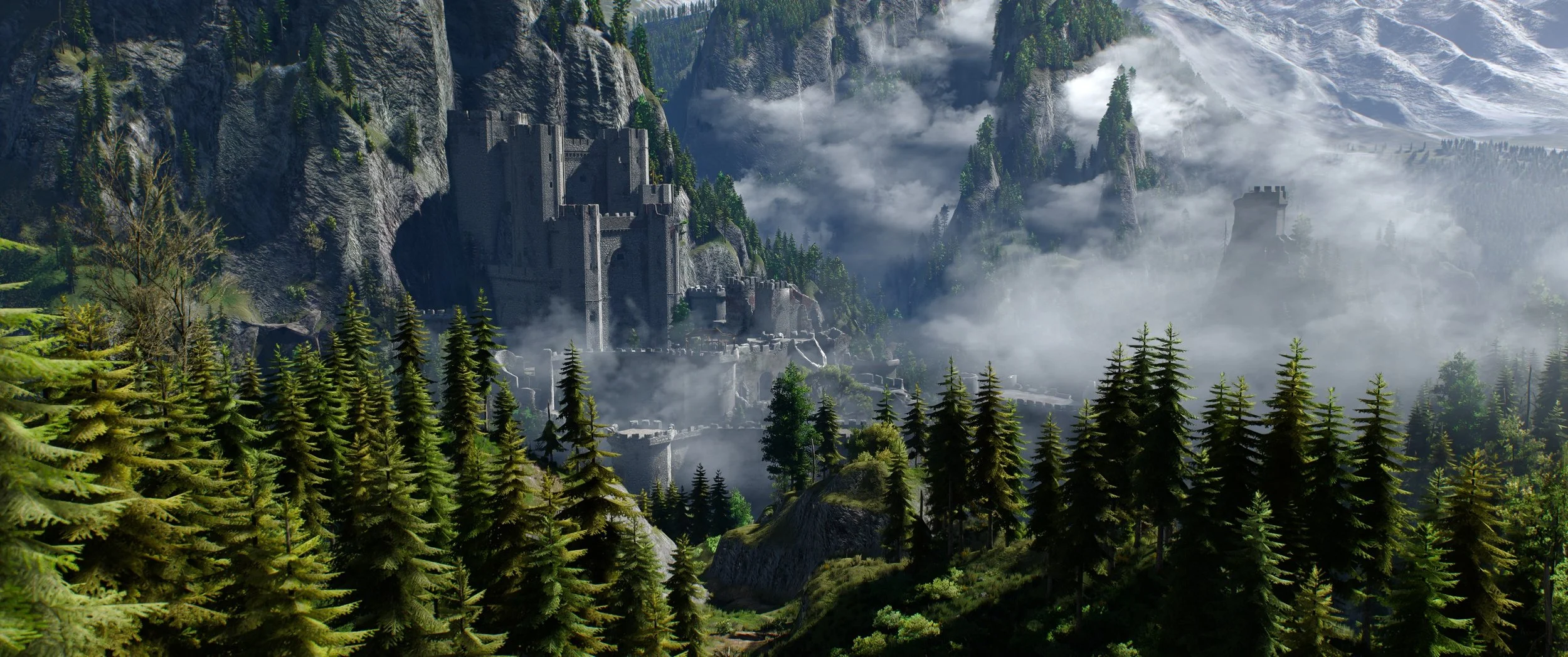
In most other games, that answer might have been yes. However, the Witcher 3 sacrifices being a fun playground to move through in favor using its open world as a tool to bring its narrative to life. When viewed through this lense, the open world begins to click. You'd be hard pressed to find a single solitary pocket of happiness in Velen's dreadful countryside, but as you learn about how to the Third Northern War has turned it into a wasteland, it's intentionally barren design feels more purposeful to move through. Upon first arriving, Novigrad presents like any other medieval Eastern European-inspired city you've seen in other games or movies. That all changes very quickly once Geralt's numerous sagas with Triss and Djikstra reveal a city brimming with points of interest that would never make themselves known to the unsuspecting eye. Simply put, the world of the Witcher 3 isn't meant to be a playground for the player, it's designed as a playground for the story, and this game is much better for it.
When the Witcher 3's open world isn't serving its story, it's delivering a stunning visual experience that I found difficult to take my eyes off of. Even in the swamps of the crookback bog, or in the cold, harsh islands peppering the Skellige region, each environment felt authenticate and believable. It's open-zone design may disappoint players who prefer connected landscapes, but it allows each region to more effectively live and breathe as it's own distinct world, while remaining connected through the strands of the game's overarching narrative. A world that is designed to be oppressively bleak that also delivers countless moments that forces players to stop and smell the roses is a remarkable artistic achievement, and one of the main reasons why the Witcher 3 a timeless masterpiece.
Aging Like Fine (Blood and) Wine
In an interview with PC Gamer, Executive Producer Jakub Kutrzuba stated, "We wanted to make it [comparable] with any other game which is launching these days," when discussing how he and his team approached designing the remaster. Re-working a game to cater to the sensibilities of an entirely new generation of gamers is a tall task, but it's an important one for this game in particular. It's the type of must-play experience that illustrates to the players of today and tomorrow that the story-rich RPG is not just an important gaming genre, it's a rich art form that has the power to transform the medium. To that end, I came to the Witcher specifically because of the remaster, and put in a solid 30 hours leading right up to its release to ensure that I could feel the full effect of its changes. So, did they work?
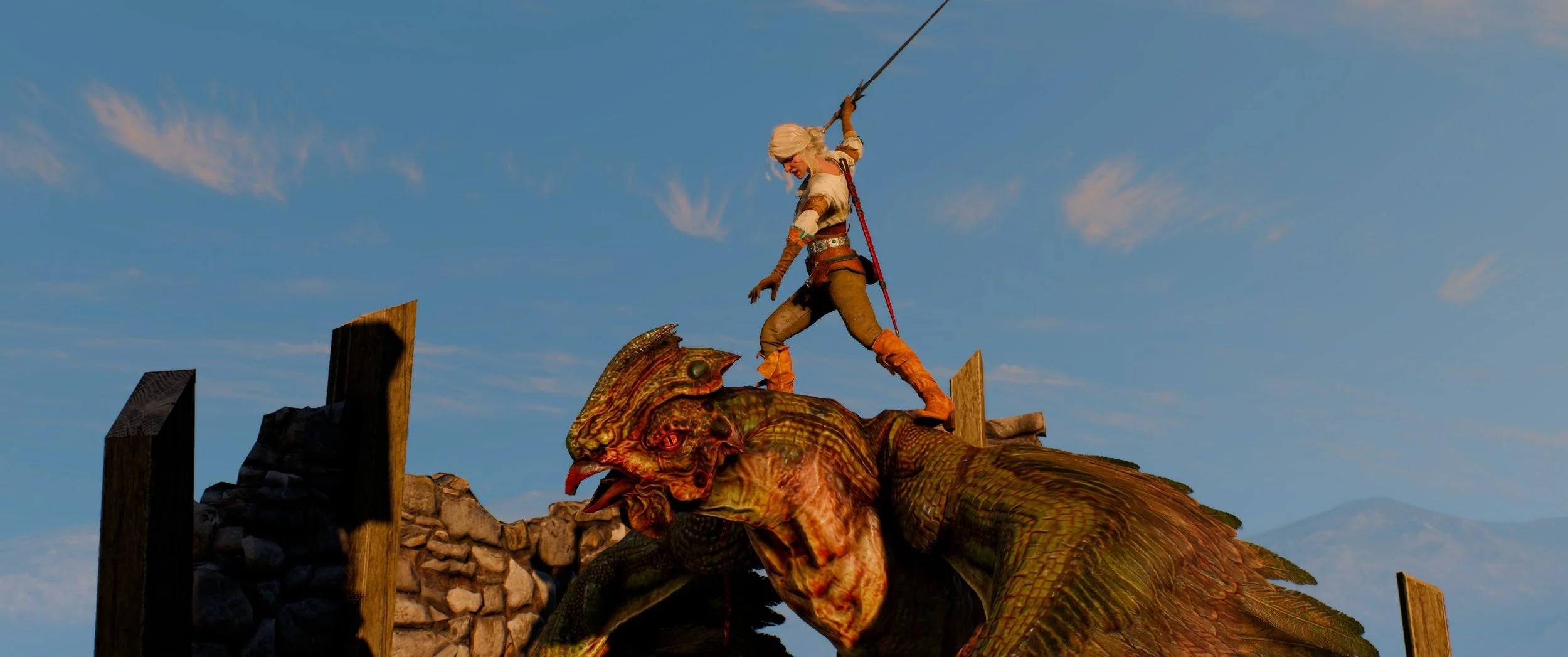
The first thought I had when loading up my first remaster save was "Wow, this is breathtaking." Picking up where I had left off during the evening time in Velen, the sunset cast a warm glow through the forest trees with a renewed sheen that felt mesmerizing. The lush foliage blowing in the wind transformed from simple environmental set-dressing to an immersive calm that beckoned me to meditate. Then, that's exactly what I did, and suddenly, I was watching Geralt enter a deep state of reflection as time marched on around him. Once I uncovered one change, I found myself stumbling over them one after another. Clean menus, an organized skill tree, clever and thoughtful accessibility settings -- a host of small changes that when brought together made the Witcher 3 a more fun game to contend with. Though, and perhaps most important, it still felt like the Witcher 3.
“…Once I uncovered one change, I found myself stumbling over them one after another.”
Facial detail has been enhanced, but talking to my companions still conjured the same distinct feelings as before. Moment-to-moment combat feels slightly snappier, and encounters feel more "modern" as a result, but Geralt doesn't necessarily feel like a whole new character to walk into battle with. With this in mind, did CDPR achieve its goal of making the Witcher 3 feel like a game launching in 2026? My verdict is yes. You probably won't feel the dozens of changes the remaster brings in a tangible way, but the point wasn't to completely overhaul the game. It was to make the Witcher 3 the best version of itself that it could possibly be -- and they've done that in convincing fashion.
The Verdict
In 2026, my goal was to go on a grand adventure. To have the impact of a game's story transcend the screen into my real life experience. I didn't want to escape into a world, I wanted to live in it and walk every step. I didn't want to just talk to my companions, I wanted to live in their world, their circumstances, their trials and tribulations. I wanted to dive into a game that tested my moral compass, and pushed me to imagine what I would do if I had the power to hold fate in my hands. Most of all, I wanted to exist in a world that was bigger than myself, or my character. The Witcher 3 delivered that adventure, those characters, and that world. It's not perfect, rather, it's a textbook example of why a masterpiece does not equate to a flawless experience. This game is an enduring masterpiece, nonetheless. A genre-defining work of art, and an ever-present reminder that video games are the most powerful intersection of technology and art that exists.